Research · Biophysics
Conformational Ensembles of the Disordered IA3 Protein
Expressing, purifying, and structurally characterizing two never-before-studied variants of an intrinsically disordered yeast protein with circular dichroism spectroscopy. Awarded Best Paper among 71 international participants.
The question
About half of human proteins are intrinsically disordered: they have no single stable 3D shape. Disordered proteins are central to aggregation diseases such as Alzheimer’s and Parkinson’s, and their structure–function rules are still being worked out.
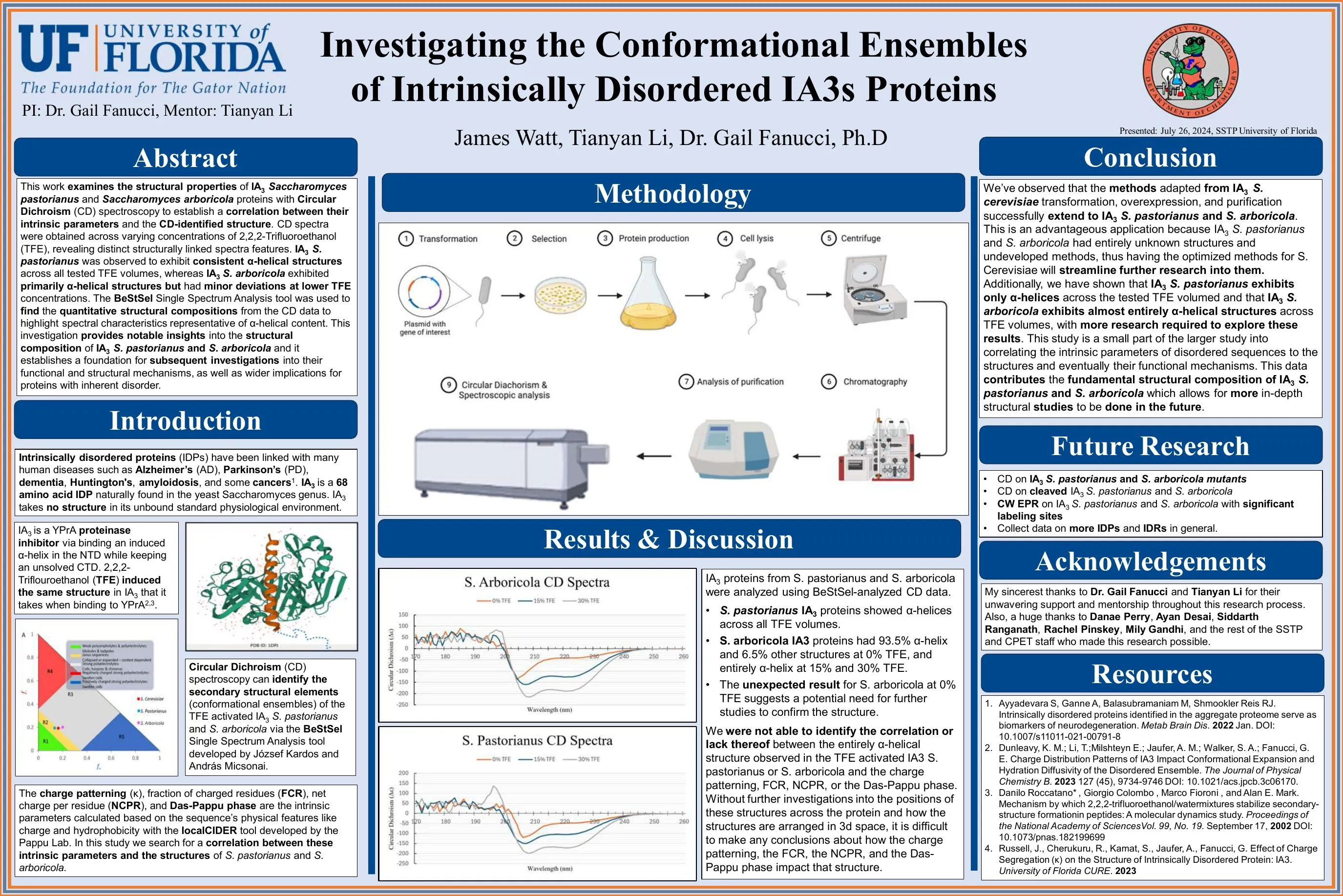
IA3 is a 68-residue disordered protein from Saccharomyces yeast that inhibits the protease YPrA. On its own it is unstructured, but when it binds, its N-terminal half snaps into an α-helix. The solvent TFE induces that same structure in the lab. IA3 from S. cerevisiae is well studied; the variants from S. pastorianus and S. arboricola had never been structurally characterized, and no methods existed for producing them.
What I did
- Protein production. I transformed E. coli with plasmids encoding each IA3 variant and overexpressed the proteins, adapting the protocol developed for S. cerevisiae IA3.
- Purification. I lysed the cells by sonication and heat, purified the proteins by nickel-affinity FPLC while monitoring at 280 nm, dialyzed them, and measured concentration by UV-vis absorbance.
- Structure. I recorded circular dichroism (CD) spectra at 0%, 15%, and 30% TFE and quantified secondary-structure content with the BeStSel single-spectrum analysis tool.
- Sequence analysis. I computed each variant’s charge-patterning parameters (κ, fraction of charged residues, net charge per residue) with localCIDER and placed them on the Das–Pappu phase diagram, to test whether sequence predicts structure.
Results
- The S. cerevisiae methods transfer successfully to both new variants. That gives the lab a working pipeline for proteins that previously had none.
- S. pastorianus IA3 is entirely α-helical across every TFE concentration tested.
- S. arboricola IA3 is 93.5% α-helix (6.5% other structure) at 0% TFE, and entirely helical at 15% and 30% TFE. The 0% result was unexpected and needs follow-up.
- The charge-patterning parameters did not show a clear correlation with the observed structure. That will take residue-level structural data, such as CW EPR on labeled sites, to resolve.
Recognition
The paper won Best Paper among 71 international participants in UF’s 2024 Student Science Training Program.
Watt, J. R.; Li, T.; Fanucci, G. E.; Hinson, E. Investigating the Conformational Ensembles of the Intrinsically Disordered IA3s Proteins. doi:10.13140/RG.2.2.30993.85603
Read the paper
Investigating the Conformational Ensembles of Intrinsically Disordered IA3s Proteins
J. R. Watt, T. Li, G. E. Fanucci · UF Student Science Training Program, 2024 · Best Paper award
Your browser can't show the PDF inline. Open the PDF instead.