Research · Astrophysics
BVRI Photometry and Isochrone Ages of Two Open Clusters
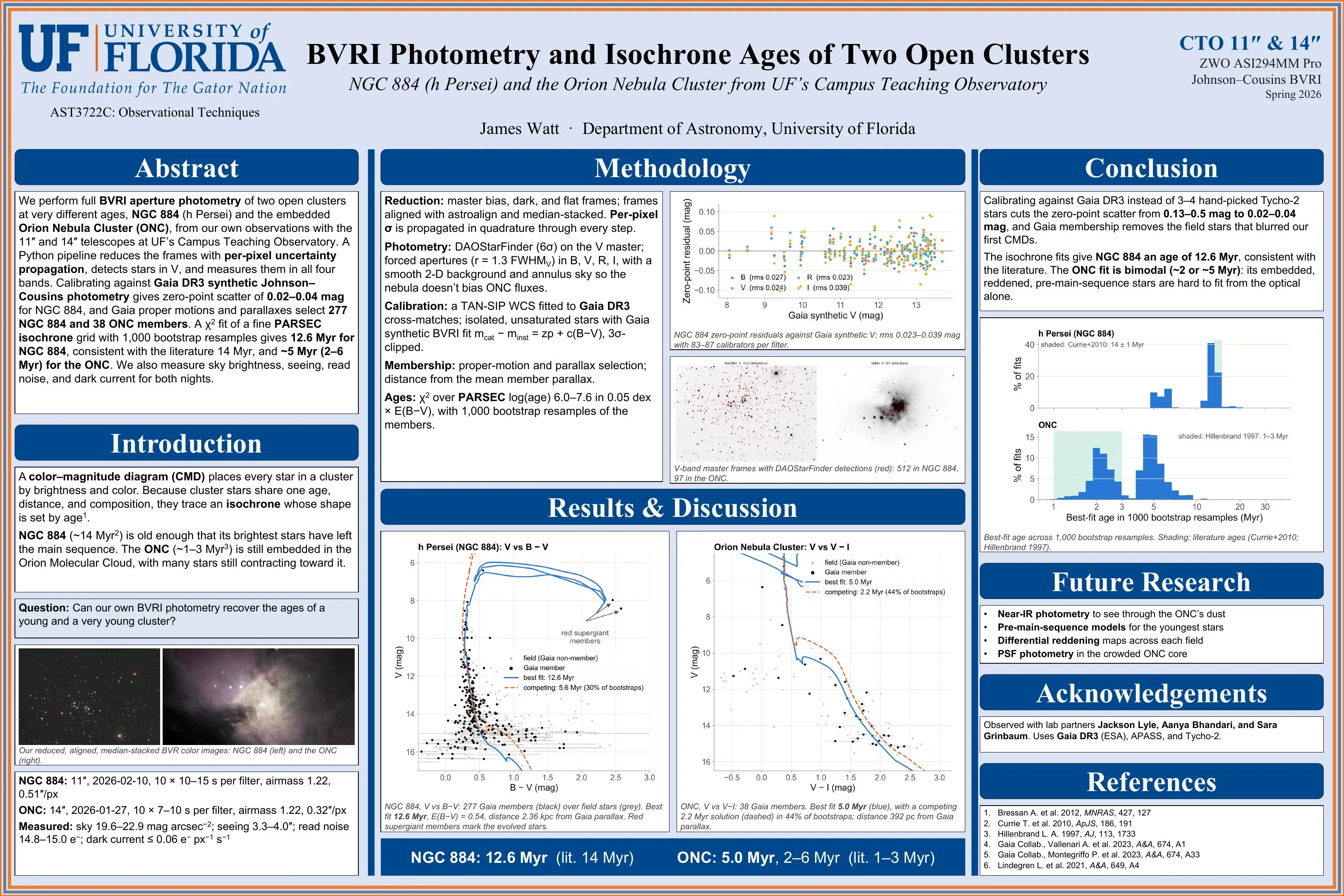
I reduced our own telescope data of NGC 884 and the Orion Nebula Cluster, measured every star in four filters, and fit stellar isochrones to date both clusters. After recalibrating against Gaia DR3, NGC 884 comes out at 12.6 Myr, consistent with the literature.
The question
A color–magnitude diagram places every star in a cluster by brightness and color. Because a cluster’s stars share one age, distance, and composition, they fall along an isochrone whose shape is set by age. We observed two clusters at very different stages: NGC 884 (h Persei, about 14 Myr old), whose brightest stars have already left the main sequence, and the Orion Nebula Cluster, still embedded in its birth cloud at 1–3 Myr. Could our own BVRI photometry recover both ages?
What I did
- Observations. My lab group imaged both clusters in B, V, R, and I with the 11″ and 14″ telescopes at UF’s Campus Teaching Observatory, on ZWO ASI294MM Pro cameras.
- Reduction. I built a Python pipeline that calibrates and median-stacks the frames and propagates a per-pixel uncertainty through every step. The same pipeline measures read noise (14.8 e⁻), dark current (≤ 0.06 e⁻ px⁻¹ s⁻¹), sky brightness (19.6–22.9 mag arcsec⁻²), and seeing (3.3–4.0″).
- Photometry. Stars are detected in the V master frame and measured with forced apertures in all four bands.
- Calibration and ages. For the lab report I calibrated against 3–4 hand-picked Tycho-2 stars and compared the CMDs to a coarse isochrone grid. For the poster I redid this step properly: a WCS solution against Gaia DR3, 80+ Gaia calibrators per filter, proper-motion and parallax membership, and a χ² fit of a fine PARSEC grid with 1,000 bootstrap resamples.
Results
| Lab report | Poster re-analysis | |
|---|---|---|
| Zero-point scatter | 0.13–0.5 mag | 0.02–0.04 mag (NGC 884) |
| NGC 884 age | 10–30 Myr | 12.6 Myr (literature 14 Myr) |
| ONC age | ≤ 10 Myr | 5.0 Myr, 2–6 Myr (literature 1–3 Myr) |
The NGC 884 fit lands close to the published age, and its red supergiants sit where the isochrone predicts. The ONC fit splits between about 2 and 5 Myr: its young stars are still contracting, heavily reddened, and partly hidden by dust, which is hard to untangle from optical photometry alone.
Read the paper
Lab 7: Photometry and a CMD
J. Watt, with lab group J. Lyle, A. Bhandari, S. Grinbaum · AST3722C, University of Florida · April 2026 · The original lab report; the poster's calibration and ages come from the later re-analysis.
Your browser can't show the PDF inline. Open the PDF instead.